


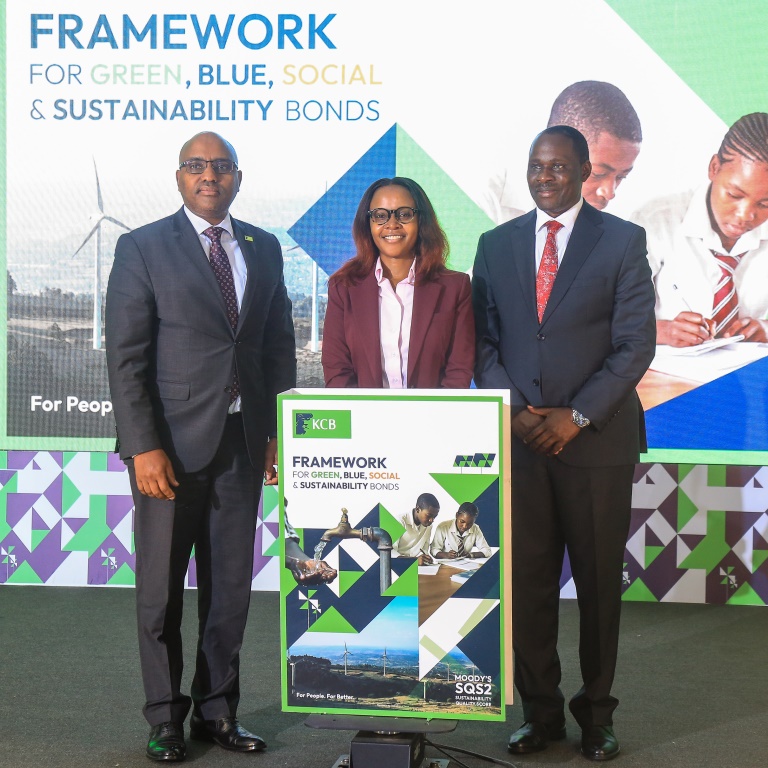
KCB Group has unveiled a Sustainability Bond Framework that could unlock long-term financing for green projects, businesses and social initiatives across East Africa over the next 5 years.
The framework lays the foundation for a planned KSH300 billion Medium Term Note (MTN) Programme with the first tranche targeting up to KSH100 billion. The transaction is subject to the necessary regulatory approvals. Unlike conventional borrowing, the proposed programme will ring-fence funds for specific Green, Blue and Social projects, directing capital towards investments expected to deliver environmental and social benefits.
This means money raised through the programme will not simply go into KCB’s general pool of funds. It will be allocated to projects that meet the eligibility requirements set out in the sustainability framework, giving investors greater clarity on how their capital will be used.
The eligible areas span some of East Africa’s key development needs including renewable energy, green buildings, clean transportation, sustainable water management, agriculture and Blue economy. On the social side, the framework will support affordable housing, micro, small and medium enterprises (MSMEs) women and youth led businesses, employment and livelihood creation.
Building on existing green financing
The new framework comes as KCB is already expanding its sustainable lending portfolio. In 2025 the group disbursed KSH48.8 billion in Green Financing, supporting areas including renewable energy, sustainable agriculture, green buildings, clean transport and water management. Green loans accounted for 25.84% of the group’s loan portfolio exceeding its 25% target of the year.
The new bond framework therefore gives the lender another avenue to mobilize capital for sustainable investments moving beyond traditional bank lending towards longer-term capital market financing.
The direction of the funds
The Green component will cover projects such as renewable energy, energy efficient buildings, clean transportation and sustainable water systems.
The Blue component brings financing to the region’s marine and fresh water economy. This can include the activities and projects linked to the sustainable use and protection of water and marine resources.
The Social component focuses on areas such as affordable housing and access to finance for undeserved businesses and entrepreneurs. For MSMEs, women and youth led enterprises in particular, access to patient and affordable capital can be critical to expanding operations, creating jobs and building more resilient businesses. The inclusion of these enterprises also gives the framework a direct connection to employment and economic inclusion, rather than limiting sustainable finance to large environmental projects.
How KCB will track the funds
A key part of the framework is the process for deciding which projects qualify for financing. KCB says it has established processes for the identification, evaluation and selection of eligible projects with proceeds to be tracked against the specified categories. This is because sustainability bonds rely on investors being able to see a clear link between the money raised and the project it is intended to finance.
The framework has also received a sustainability quality score of SQ 2- very good from Moody’s providing an external assessment of the framework’s sustainability credentials. The external assessment adds another layer of credibility to the framework, particularly for investors assessing whether projects and financing structures meet recognized sustainability standards.
A bigger role for sustainable finance
KCB’S move comes as banks across the region increasingly look beyond conventional lending to mobilize capital for climate resilience and inclusive economic development. Large scale investment in renewable energy, water infrastructure, sustainable energy, sustainable agriculture and affordable housing require significant amount of long term capital. At the same time businesses and entrepreneurs often require financing that can support expansion over several years rather than short term working capital.
For KCB, the planned bond programme provides an opportunity to bring capital market investors into some of these sectors while diversifying the Group’s sources of funding. It also reflects a broader shift in the financial sector, where sustainability is increasingly becoming part of how capital is raised and deployed rather than being treated solely as a corporate social responsibility issue.
From capital to impact
KCB Group CEO Paul Russo said the framework builds on work the group has undertaken over the past two decades to develop innovative financial solutions and support investments with economic and social impact. ‘’The launch of the Sustainability Bond Framework is a natural progression of the work that the Group has been doing over the last two decades to structure innovative financing solutions and support investments that have a meaningful economic and social impact,’’ Mr. Russo said. ‘’This is about bringing capital, purpose and accountability and using finance as a force of good while creating sustainable value for all our stakeholders.’’
The proposed programme will now move towards its first tranche up to KSH100 billion subject to regulatory approval. The first tranche will provide an early indication of investor appetite KCB’s sustainability focused financing and the bank’s ability to transform the framework into actual projects.
If successfully executed, the wider KSH300 billion programme could provide a significant new pool of capital for projects and businesses at the center of East Africa’s transition towards a low carbon, climateresilient and inclusive economy.
For KCB, the ambition is clear; turning sustainable finance from a financing theme into a larger source capital for the region’s next phase of growth.


