



Across East Africa, a profound structural shift is underway within the retail landscape: where the conventional playbook for entry into Kenya’s commercial sector once required formal corporate employment, banking capital, and investments in traditional real estate, a dynamic generation of digital-first founders is now rewriting those rules by turning market inefficiencies into high-velocity opportunities. This transformation is particularly stark in Nairobi—a regional hub where rapid urbanization, high mobile penetration, and an expanding leisure culture have converged—fueling a surge in demand for specialized apparel like resortwear and boutique beachwear from young consumers prioritizing domestic travel and curated experiences. Stepping in where traditional retail conglomerates were slow to adapt, these agile entrepreneurs are bridging the gap and reshaping the region’s retail environment.
At the centre of this movement is twenty six year old Ruth Gitau, the founder and chief executive officer of Bikini Closet. Her trajectory offers a masterclass in how modern, youth-led enterprises bypass traditional corporate gatekeepers by combining acute market intuition, digital distribution networks, and raw commercial grit.
Entering the workforce at just eighteen years old, Ruth’s early exposure to the realities of labour cultivated a sharp business instinct long before she ever set foot in a corporate boardroom. While her initial academic aspirations leaned toward medicine, the pull of commerce proved far more decisive. She recognized early that in a rapidly evolving economy, waiting for formal employment or ideal market conditions was a luxury few could afford.“I wanted to be amedical doctor, but business called me by my two names,actually three,” Ruth reflects. “If someone told my fifteen- year-old self I’d be driving by now, I’d believe them because I’ve been very focused, hardworking, na kujituma siku zote.”
Ruth’s journey embodies the broader paradigm shift defining Gen Z entrepreneurship across Kenya: an absolute willingness to start small, leverage accessible digital channels, and build commercial credibility through relentless consistency rather than massive initial capital outlay.
The genesis of Bikini Closet and the strategic supply pivot
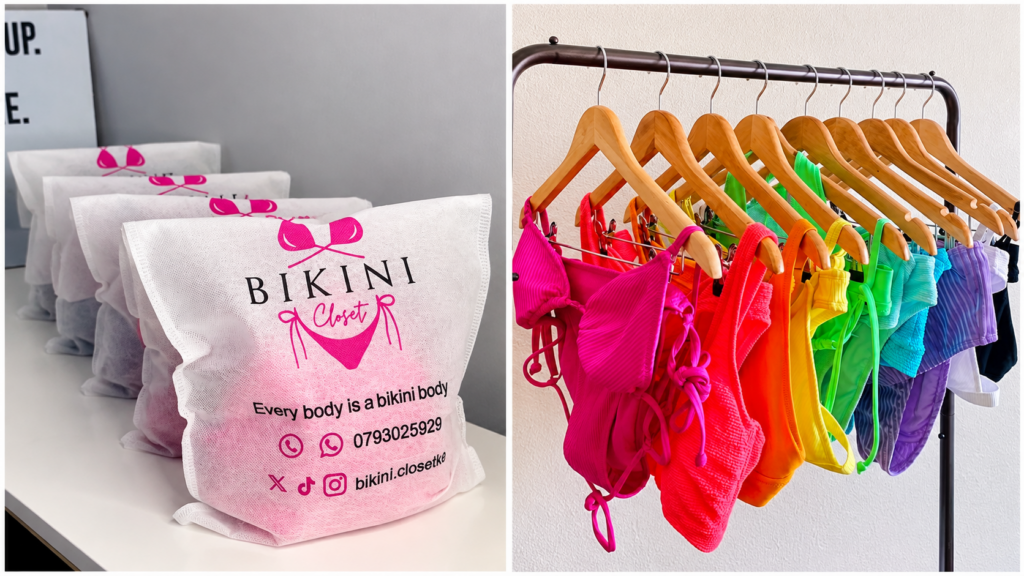
The story of Bikini Closet did not begin with institutional venture backing or a multi-year corporate strategy; it began in November 2023 out of pure economic necessity. Fresh out of university and facing the immediate financial pressures familiar to many young graduates, Ruth needed a platform to generate immediate cash flow during the festive season.
Observing the seasonal spike in leisure travel toward the Kenyan Coast and local holiday destinations, she identified an acute market imbalance. While demand for vacation apparel was high, consumers faced a frustrating choice: either pay exorbitant prices at high-end hotel boutiques or spend hours scouring informal open-air markets like Gikomba to piece together an outfit.
Ruth saw an opportunity to curate these essentials into a cohesive, accessible offering. What was initially conceived as a temporary, short-term holiday hustle transformed almost instantly upon launch.“I was broke right from campus, so I had to think fast,” she explains.
“Selling beach or vacation essentials was the first thing in mind considering it was the festive season. I was only thinking of it as a short-term thing, but with time, I started getting great ideas about it and seeing it as a brand rather than just a source of income.”
The initial market response was awesome. Within days of posting her curated catalogue on social media, inbound orders began pouring in. The velocity of these early sales forced a rapid shift in her operational mindset. She realized that success in fashion retail is rarely about inventing entirely new products; rather, it hinges on curation, taste, and reliability.
“I knew I had good taste in fashion, beauty, and a lot of things,” Ruth quips. “If I bring something, people will just like it, because if I’m liking it, why wouldn’t you?”
However,the rapid growth quickly exposed the business to supply chain challenges. Sourcing inventory through informal wholesale channels presented distinct limitations in quality control, stock volume, and consistency. As demand outpaced supply, Ruth recognized that to build a sustainable enterprise, she had to move away from piecemeal sourcing and begin scaling her minimum order quantities (MOQs). Overcoming Gikomba’s supply deficits became a primary operational objective, prompting her to seek direct relationships with larger suppliers to ensure consistent quality and volume for her growing customer base.
This operational pivot marked the transition of Bikini Closet from a seasonal online shop into a structured, forward-looking commercial brand.
Financial discipline and the sisterhood investment engine
As any seasoned founder understands, early commercial traction can be deceiving. The true test of an enterprise lies in its ability to navigate the transition from top-line revenue generation to disciplined financial management. For Ruth, that crucible arrived approximately three months into operations.
In the initial surge of sales, the influx of daily cash flow created an illusion of liquidity a common trap that leads many early-stage entrepreneurs to conflate gross sales with personal wealth. Realizing that long-term viability required rigorous accounting, Ruth undertook a complete overhaul of her personal and business finances.
Reflecting on her early operational journey, Ruth identifies her inability to separate gross revenue from true net profit during her first three months in business as a pivotal learning crucible. She warns that without strict accounting standards, incoming cash flow easily creates an illusion of personal wealth, leading founders into the dangerous trap of spending capital that belongs to the business (utakulapesayabiashara). To build a resilient enterprise, she stresses the non-negotiable discipline of establishing distinct bank accounts for personal and business use, systematically recording cash flows, and protecting operating funds. Without this financial rigour, an entrepreneur risks exhausting critical working capital, leaving the business vulnerable when immediate liabilities—such as restocking inventory, settling vendor invoices, and meeting employee payroll—inevitably come due.
She implemented strict accounting standards: tracking every expense, preparing monthly income statements, cash flow tracking, and establishing a dedicated reserve fund to insulate the business against supply chain shocks. Every shilling earned was systematically evaluated and channeled back into inventory, marketing, and operational infrastructure.
This financial discipline laid the foundation for the enterprise’s next major milestone: transitioning from a shared shelf-rental model to a fully-fledged, dedicated physical retail boutique.While the digital storefront was driving revenue, lack of physical space was constraining inventory capacity and customer engagement. However, taking on a commercial lease in Nairobi represented a significant financial commitment and a daunting operational leap. The decisive catalyst came from an unexpected source: sisterhood.
Accompanied by her two sisters, Maggie and Hope, both successful entrepreneurs in their own right, Ruth went out one afternoon intending merely to support them in their commercial property search. Instead, her sisters turned the mirror on her.
Recalling the pivotal moment that catalyzed her transition to physical retail, Ruth shares that she had not initially planned to look for a commercial store for herself. Instead, she was simply accompanying her sisters, Maggie and Hope—both fellow business owners—to support their own property search. Once at the location, her sisters turned the focus onto her, challenging her to stop making financial excuses and open a dedicated shop for Bikini Closet. By dismantling her hesitations and providing practical solutions for every financial concern she raised, her sisters gave her the push she needed to take the leap into a full-scale retail space.
Having a physical retail location for the brand had been anchored on her vision board since the start of the year, even when the precise timeline remained uncertain. Yet, true growth often follows an intuitive internal clock, a quiet, undeniable realization that the moment to act has finally arrived. This milestone underscores a fundamental truth in building an enterprise: the vision frequently precedes the ideal timing. Success lies in trusting the quiet work of building, maintaining structural readiness, and having the courage to leap when conviction and opportunity finally align
Despite her initial anxiety about moving from a low-overhead shelf payment to a full commercial lease, Ruth’s optimism, her trust for the growth of the business and her confidence with her business skills anchored her decision. She paid the deposit that very day. Drawing on a clear aesthetic blueprint she had long maintained on her personal vision board, Ruth designed the store layout in a single day, contracted local artisans, and opened the doors to Bikini Closet’s physical home within a week.
Transitioning from its initial operations to its physical expansion phase, Bikini Closet underwent a significant structural evolution across every key operational dimension. In its early stages throughout 2023, the enterprise relied on a shared rented shelf and digital orders, managed through informal revenue collection and funded via personal micro-savings, while its supply chain depended on spot sourcing with low minimum order quantities (MOQs). Today, the business operates as a dedicated physical boutique integrated into a multi-channel retail model, supported by rigorous financial governance, including structured income statements, cash flow tracking, and dedicated reserve accounts. This growth has been sustained by a capital strategy centred on the systematic reinvestment of operating profits, alongside an upgraded supply chain featuring scaled MOQs and direct supplier networks.

The psychology of retail experience and digital commerce engine
In an era dominated by automated commerce and impersonal transactions, Bikini Closet built its market position by anchoring its retail operations in deep customer empathy and radical inclusivity.
For Ruth, a physical store is not merely a distribution node; it is an experiential space designed to foster community, trust, and psychological comfort. Recognizing that shopping for beachwear and resort attire can often induce self-consciousness for many women, she intentionally cultivated a store environment centred on warmth and positive energy.
The shop is designed to offer customers more than a conventional retail experience, with a strong emphasis on personalised service, comfort and inclusivity. Customers are welcomed into a relaxed environment where they can interact freely with the team, share a laugh and enjoy an experience that feels more personal than transactional. This approach extends to the business’s philosophy of treating every customer equally, regardless of their background, profile or social status. From high-profile personalities to everyday shoppers, the aim is to create an environment where everyone feels comfortable, valued and genuinely welcome.
This commitment to egalitarian customer service is paired with an operational model focused on convenience. By consolidating vacation outfits, bikinis, footwear, and accessories under a single roof, Bikini Closet eliminated the fragmented shopping experience typical of Nairobi’s urban retail scene. Furthermore, for time-constrained travellers, the enterprise built a rapid-response delivery network capable of fulfilling local orders within thirty toforty minutes.
Complementing this physical retail experience is a highly disciplined social media strategy. Understanding that digital perception directly dictates brand equity. Ruth made her first major capital investment in high-quality hardware, purchasing a top-tier iPhone specifically dedicated to content creation.
That single decision transformed the brand’s digital reach. High-definition visual assets immediately elevated the perception of the products, capturing the attention of social media algorithms on platforms like Instagram and TikTok. By consistently posting engaging, behind-the-scenes content detailing the realities of building an enterprise, her posts frequently achieve viral status.
“If a video goes viral, we know that week is going to be a long, good week,” Ruth explains. “People will call, message us, and come to the shop. The biggest challenge comes when that product sells out completely. It’s a good feeling for us to sell out, but we always work to keep up with that demand.”

Rapid-fire insights and the next frontier
As Ruth looks toward the future, her strategic focus is trained firmly on institutional growth, geographic expansion, and long-term brand equity. Her blueprint for the next five years includes expanding Bikini Closet’s physical footprint across major regional hubs, significantly scaling product lines, and forging international distribution partnerships to bring global brands into the local ecosystem while exporting Kenyan style to the world.
In a quickfire profile, Ruth distills her entrepreneurial journey down to a single defining word: faith. A self-described night owl who prefers a sunny beach holiday over a city escape, she cites Timothy Ferriss’sThe 4-Hour Workweek as her must-read business guide. Had she not taken the leap into building her brand, she envisions she would be practising medicine as a doctor. Addressing common misconceptions, she counters the belief that she has everything completely figured out, anchoring her mindset instead in the best piece of advice she ever received—”Start before you’re ready, and figure it out along the way.” Ultimately, her guiding philosophy for aspiring founders is simple yet profound: give yourself the grace and room to make mistakes, learn, and grow.
Ruth’s journey stands out as a compelling testament to the transformative potential of East Africa’s young entrepreneurs. By marrying creative vision with financial discipline, she has demonstrated that sustainable brands are built not on massive initial capital, but on consistency, customer empathy, and the courage to execute.
For any young entrepreneur standing on the threshold of their own commercial journey, Ruth concluded with a powerful rallying cry for the next generation of founders. She challenges the notion that youth is a barrier in business, arguing instead that starting early gives entrepreneurs a distinct competitive edge, providing the time, energy, and freedom to experiment and learn from failure. Her parting advice to aspiring business owners is simple and direct: begin immediately, regardless of capital or certainty, and embrace the process of figuring things out along the way. Above all, she emphasizes that unwavering consistency and perseverance are essential, reminding new founders that no matter the initial obstacles, there is always light at the end of the tunnel.


