


HassConsult’s Q3 2026 indices reveal a widening performance gap in Nairobi’s property market, with established suburbs recording stronger property and rental growth while satellite towns experience moderating prices and slower market activity.
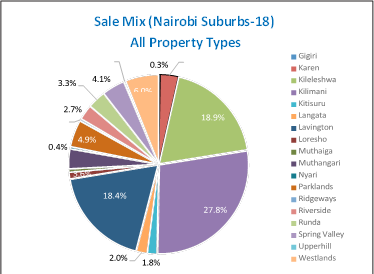
Kenya’s property market is undergoing a period of adjustment, with emerging differences in performance across residential locations reshaping the investment landscape. The latest HassConsult Land Price and Property Price Indices for the third quarter of 2026 point to a growing divide between established Nairobi suburbs and satellite towns, highlighting the increasing importance of location, affordability and market demand in determining property values.
While established neighbourhoods recorded renewed growth in residential property prices and rental values, satellite towns experienced a more subdued performance, with some locations registering declines. The findings suggest that the property market is becoming increasingly differentiated, requiring investors and developers to adopt more deliberate, evidence-based investment strategies.
Established Nairobi Suburbs Record Stronger Growth
According to the HassConsult Property Price Index, property asking prices in Nairobi’s established suburbs increased by 2.3 per cent in the third quarter, bringing the average price to KSh33.88 million. This compares with growth of 0.9 per cent in the preceding quarter and represents the strongest quarterly appreciation in four years.
Spring Valley led the market, recording a 6.8 per cent increase in house asking prices to an average of KSh79.4 million. Westlands followed with growth of 5.9 per cent, while Muthaiga registered a 5.5 per cent increase. Karen and Loresho each recorded growth of 5.2 per cent.
The performance reflects continued demand for established residential locations, supported by mature infrastructure, accessibility and proximity to commercial and employment centres.
Improving credit conditions have also provided support to the market. HassConsult cites Central Bank of Kenya data indicating that average commercial bank lending rates declined from 17.2 per cent in November 2024 to 14.4 per cent in September 2026. Annual private-sector credit growth reached 10.6 per cent in September 2026, creating a more supportive financing environment for property buyers and investors.
Rental Market Maintains Positive Momentum
The rental market recorded a similar improvement, with rental asking prices in Nairobi’s established suburbs increasing by 2.7 per cent during the quarter, up from 1.4 per cent in the previous quarter. Annual rental growth stood at 7.1 per cent.
Loresho recorded the strongest quarterly increase at 6.2 per cent, taking average monthly rent to KSh338,100. Kitisuru followed at 5.1 per cent, while Muthaiga registered growth of 4.5 per cent.
HassConsult attributes part of the demand in established diplomatic and international neighbourhoods to the expansion of United Nations operations and the relocation of personnel to Nairobi. This reinforces the importance of specialised tenant demand in sustaining rental performance.
Satellite Towns Experience Slower Price Growth
In contrast, satellite towns recorded a weaker performance. Property asking prices across the 14 tracked towns declined by 0.6 per cent in the third quarter, marking the second consecutive quarterly contraction. The average asking price stood at approximately KSh14.43 million, while the annual index declined by 2 per cent.
Ngong recorded a 1.2 per cent decline in house asking prices, followed by Ongata Rongai at 1 per cent and Juja at 0.6 per cent. Rental growth also slowed, easing to 0.4 per cent from 1.1 per cent in the preceding quarter.
However, the performance was not uniform. Ruiru recorded quarterly house-price growth of 1.3 per cent, illustrating the importance of assessing individual locations rather than treating satellite towns as a single investment market.
The figures point to a more demanding environment for developers and investors, where affordability must be considered alongside infrastructure, accessibility, competing housing supply and the purchasing power of potential buyers.
Land Investment Requires Greater Selectivity
The slowdown extended to the land market, where price appreciation moderated across both established suburbs and satellite towns.
In Nairobi’s tracked suburbs, land prices increased by 0.7 per cent during the quarter, down from 1.4 per cent in the preceding quarter. The average price reached KSh233.5 million per acre. Satellite-town land prices rose by 0.65 per cent to an average of KSh33.7 million per acre.
Of particular significance, HassConsult’s analysis indicates that land-price appreciation in 12 of the 14 satellite towns over the past two years was lower than the modelled returns from rolling 91-day Treasury bills. Only Ruiru and Juja outperformed the benchmark.
The findings challenge the conventional approach of acquiring land solely in anticipation of future price appreciation. HassConsult Co-CEO Sakina Hassanali notes that the investment case for land may increasingly depend on its intended use.
For investors, this places greater emphasis on the productive potential of land, including residential development, commercial use and income-generating opportunities, rather than relying exclusively on speculative appreciation.
A More Selective Investment Landscape
The third-quarter findings signal a property market in which investment performance is increasingly shaped by location-specific fundamentals. Established Nairobi suburbs continue to benefit from stronger residential and rental demand, while satellite towns face greater pressure to demonstrate sustainable growth.
For developers, investors and prospective homeowners, the implications are significant. Investment decisions must increasingly be guided by realistic pricing, market demand, financing conditions and the long-term utility of the property.
Ultimately, the opportunity in Kenya’s real estate sector will depend not merely on acquiring property, but on identifying assets with sound fundamentals, sustainable demand and clearly defined investment potential.
Source: HassConsult Land Price Index and Property Price Index, Quarter Three 2026. All property and rental price figures refer to asking prices, not confirmed transaction values.


