


Inaugural IFIA Awards place MSME financing, digital innovation and responsible finance at the centre of Kenya’s next phase of financial inclusion.
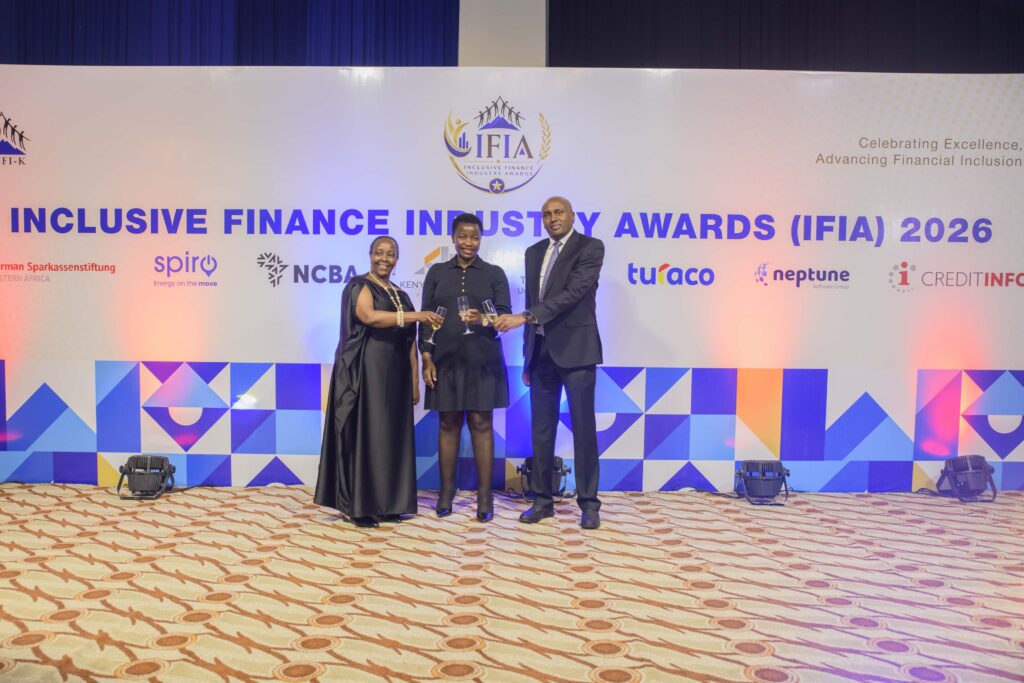
Kenya’s inclusive finance industry is placing stronger emphasis on how financial services translate into enterprise growth, investment and economic resilience, as stakeholders gathered for the inaugural Inclusive Finance Industry Awards (IFIA) 2026.
Held on August 14 at the Mövenpick Hotel & Residences Nairobi under the theme – ‘ Celebrating Leadership, Excellence and Impact in Inclusive Finance’- the awards brought together more than two hundred and sixty stakeholders from micro finance institutions, government, regulators , development finance, investment, technology and other key players in the inclusive finance ecosystem.
Hosted by the Association of Microfinance Institutions–Kenya (AMFI-K), the inaugural ceremony recognised institutions and individuals advancing financial inclusion while creating a platform for discussions around the future of financing for Kenya’s underserved markets.
The event placed MSME financing, digital innovation, responsible finance and economic empowerment firmly on the industry agenda, reflecting an evolving understanding of financial inclusion beyond simply expanding access to financial services.
MSME financing takes centre stage
Micro, small and medium enterprises were a major focus of the discussions, amid persistent challenges around access to affordable and appropriately structured capital.
Speaking at the ceremony, AMFI-K Chief Executive Officer Caroline Karanja said financial inclusion must ultimately enable people and businesses to participate more meaningfully in the economy. “Financial inclusion is not only about access to finance; it is about creating opportunities for individuals, families and enterprises to participate meaningfully in the economy and build more resilient livelihoods,” Caroline said.
For MSMEs, the challenge increasingly extends beyond the availability of credit. Financing solutions need to take into account the realities of small businesses, including their cash flows, risk profiles, growth cycles and investment needs.
Wangaruro Mbira, Chairman, AMFI-K, noted that whereas Kenya has made great progress in bringing financial services closer to households, entrepreneurs and communities, on its own, that is no longer enough. “ Financial inclusion is now about meaningful use, quality of service, resilience, the wellness, opportunities and outcome,” said Mbira. “ Time has now come for us to position financial inclusion not simply as a social objective, but as an essential pillar of a resilient and transformative financial system; that requires measurable outcomes, commercially sound, well governed and innovative institutional framework,” he added.
The chief guest, Susan Mang’eni, Principal Secretary, State Department for Micro, Small and Medium Enterprises Development, called for stronger coordination between government, financial institutions and development partners to address these financing barriers. “Improving access to affordable, appropriate and sustainable finance would be critical to enabling MSMEs to grow, create jobs, increase productivity and contribute more significantly to the national economy,” the Principal Secretary said.
A more responsive MSME financing ecosystem could create opportunities across the wider financial sector, including lenders, fintech companies, investors, underwriters and development finance institutions, while helping viable enterprises move towards greater productivity and scale.
Digital innovation and responsible finance
Digital finance also emerged as an important component of the evolving financial inclusion landscape. Digital platforms, alternative credit assessment, data-driven lending and technology-enabled financial products are changing how financial institutions deliver services and assess customers. These tools have the potential to reduce transaction costs and reach businesses that may not meet conventional lending requirements.
However, the expansion of digital finance has also brought greater attention to affordability, consumer protection, indebtedness and the quality of financial services. The industry therefore faces the challenge of balancing innovation with profitability and responsibility, ensuring that technology improves financial access without compromising customers’ welfare.

A broader definition of inclusion
The breadth of the inaugural awards reinforced this changing landscape. The 2026 IFIA Awards featured sixteen categories covering areas including : digital financial inclusion, SME development, agricultural finance, women’s economic empowerment, youth inclusion, sustainability and ESG, WASH financing, climate resilience and leadership.
The categories recognised the increasingly specialised nature of financial needs across different segments of the economy. Agricultural enterprises, for instance, face different financing needs from urban SMEs, while climate resilience, affordable housing and youth enterprise development each require financing models tailored to their particular risks and opportunities.
The awards therefore provided recognition not only for institutional performance, but for initiatives seeking to address specific gaps within Kenya’s financial ecosystem.
Celebrating industry performance
Several institutions emerged among the notable winners at the inaugural ceremony. Caritas Microfinance Bank secured ten major awards including Microfinance Bank of the Year, Fastest Growing MFB and Best Digital Financial Inclusion Initiative. Additionally, their CEO, Mr. David Mukaru got the prestigious industry lifetime achievement award, recognizing his illustrious career in the finance sector.
Hand in Hand Eastern Africa was recognised with the Best Women Economic Empowerment Initiative and Best Youth and Inclusive Financial Initiative awards, highlighting its work at the intersection of financial inclusion and economic empowerment. Spectrum Credit Limited took the Fastest Growing Non-Deposit Taking Credit Partner (NDTCP) award, recognising its expansion in working capital and SME financing. Other notables winners were : Bimas Kenya Limited, Jawabu Biashara, VisionFund Kenya, ASA International Kenya Limited and Faulu Microfinance Bank.
The range of winners reflected the diversity of institutions contributing to Kenya’s financial inclusion agenda, from microfinance and credit providers to development organisations and digital finance players.
Independent process
As a new industry awards platform, integrity was a key component of the judging process . Submissions were evaluated by an independent jury comprising representatives from MicroSave Consulting, FSD Kenya and Musyimi & Company Advocates. AMFI-K served as the awards secretariat, responsible for coordination and administration, but did not participate in scoring or selecting the winners.
The inaugural event was supported by seven sponsors and partners and provided an additional platform for networking, industry insights and knowledge exchange among stakeholders across the financial inclusion ecosystem.
The road ahead
The discussions at the inaugural IFIA Awards point towards a financial inclusion agenda increasingly focused on productive economic participation rather than access alone.For MSMEs, farmers, women and young entrepreneurs, the value of financial services will ultimately be determined by whether they can use them to invest, build sustainable enterprises, withstand economic shocks and improve their livelihoods.
Achieving this will require greater collaboration between government, regulators, financial institutions, investors, technology providers and development partners.
For AMFI-K, the awards are intended to become an annual platform for recognising excellence, encouraging continuous improvement, facilitating knowledge sharing and strengthening collaboration across the financial inclusion ecosystem.
The inaugural IFIA Awards have therefore established more than a new recognition platform. They have opened an important industry conversation around what Kenya’s next generation of financial inclusion should deliver, and how finance can become a stronger engine of enterprise growth and economic opportunity.


