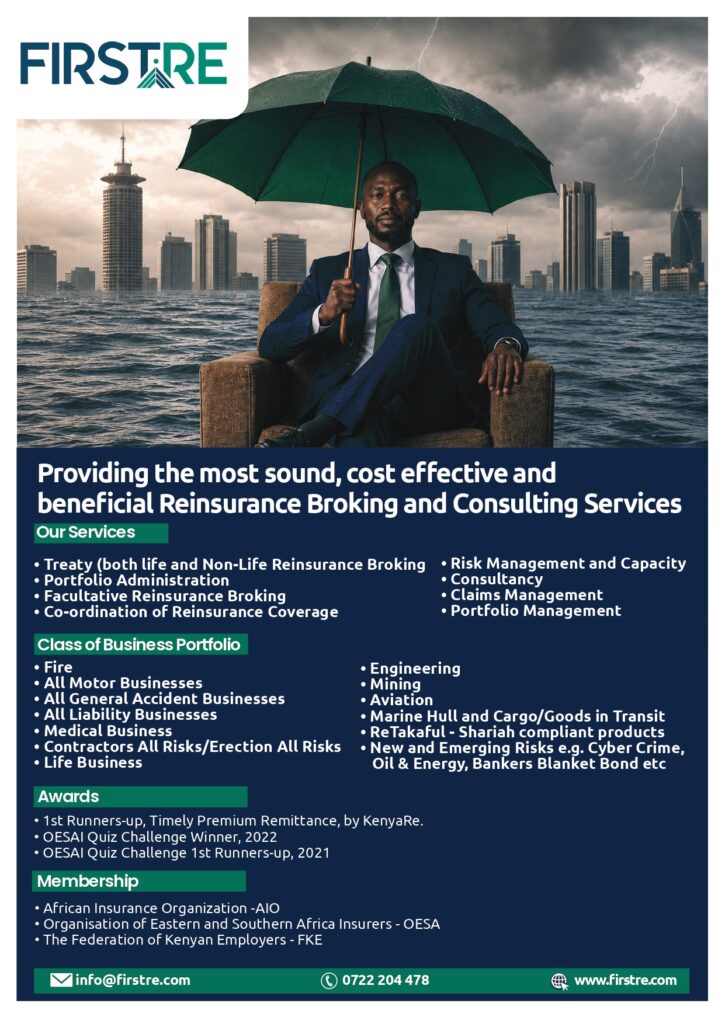
From pioneering Kenya’s local reinsurance broking industry in 1993 to building connections with global capital markets, FIRSTRE is positioning itself as a strategic partner in an increasingly complex African risk environment
To understand the significance of First Reinsurance Brokers Africa Limited’s (FIRSTRE) recent triumph at the Kenya Re industry awards, it is necessary to look at the broader ecosystem that shaped both the award and the company. As Kenya’s national reinsurer, Kenya Reinsurance Corporation operates at a critical junction in the regional risk-transfer chain, connecting local insurers with the underwriting capacity required to absorb complex risks. Within this framework, Kenya Re’s Gross Written Premium (GWP) awards are more than standard industry trophies; they reflect genuine commercial volume, market trust, and institutional scale.
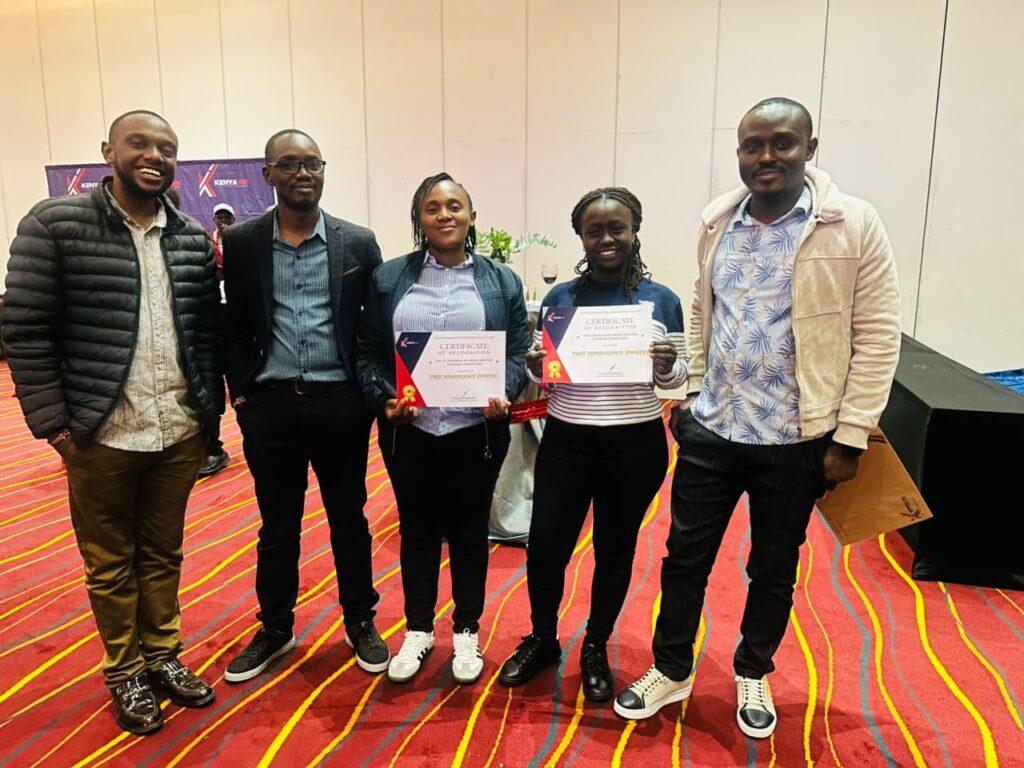
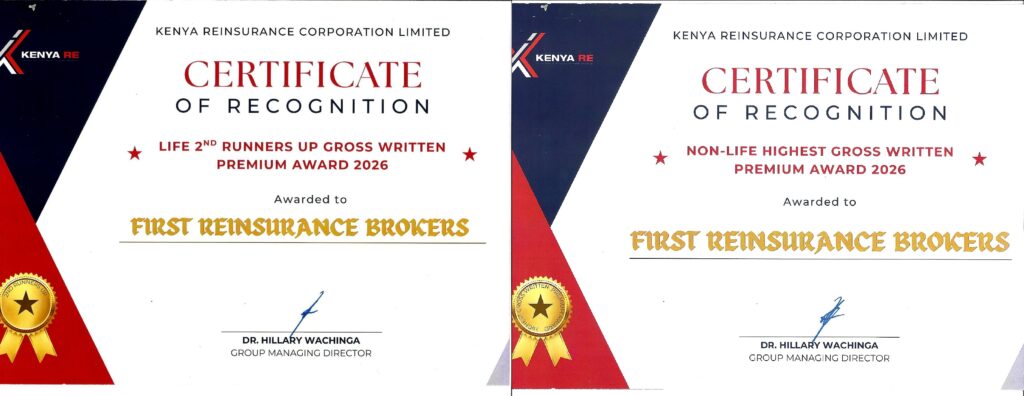
When the Group Managing Director Mr. Daniel Kathitu stepped up to accept the Highest Gross Written Premium Award in the Non-Life Brokers category (alongside recognition in the Life category), it highlighted FIRSTRE’s position at the top of that risk-transfer chain.
Yet, this recognition is best understood not as a single-year milestone, but as the culmination of a three-decade journey. When FIRSTRE was established in 1993 as Kenya’s first local reinsurance broker, it entered a market almost entirely dominated by foreign firms operating out of London and South Asia. Local institutions had limited access to custom risk-transfer strategies, relying instead on standard offshore structures that rarely matched African business realities. FIRSTRE’s entry was a deliberate bet on building local technical depth.
Thirty years later, that bet has yielded a powerhouse spanning East and Central Africa, the COMESA region, and West Africa, with direct links to capital markets in London and Asia. Viewed through this lens, Kenya Re’s recognition does not just celebrate a strong financial year, it validates a thirty -year legacy of transforming African reinsurance broking.
When risk becomes a strategic question
For many businesses, insurance begins with a relatively straightforward question: what happens if something goes wrong? For insurers and reinsurers, however, the question is considerably more complex. How much risk should be retained? How much should be transferred? What capacity is required? And how can institutions protect their balance sheets while continuing to compete for increasingly large and sophisticated business?
It is within this space that FIRSTRE has sought to differentiate itself. Under Mr. Kathitu’s leadership, the company describes its approach as an “engineering approach” to risk transfer—one that goes beyond simply arranging annual renewals and instead examines the underlying structure and performance of clients’ portfolios.
Through data analysis, FIRSTRE evaluates whether clients are carrying more capacity than they need, whether fragmented treaty arrangements can be consolidated and whether existing structures remain appropriate as their businesses evolve.
In practical terms, this can mean identifying unused limits in major lines such as fire and marine or consolidating inefficient micro-treaties into broader facilities. The objective is to create more efficient structures while improving cash flow and strengthening the client’s position when negotiating with reinsurers.
It is an approach that reflects a broader reality in financial services: technical knowledge increasingly has to be supported by data, analysis and the ability to interpret changing risk.
Containing volatility
The challenge becomes even greater when the risks themselves are volatile. Political violence, terrorism, performance bonds, supply-chain disruptions, currency movements and other macroeconomic pressures can introduce significant uncertainty into an insurer’s portfolio.
FIRSTRE’s response has been to structure these risks deliberately rather than allowing volatility in one part of a portfolio to undermine the performance of another.
The company describes this philosophy as ‘quarantining volatility’, using structures such as Quota Share, Excess of Loss and specialised Facultative placements to isolate higher-risk exposures while protecting core general insurance portfolios.
The significance of this approach lies in its long-term view. Risk transfer is not simply about finding someone else to assume an exposure. It is about designing a structure that remains sustainable for the insurer, the reinsurer and, ultimately, the customer.
From placing risk to understanding it
The risks facing businesses today are also becoming less conventional. A company can be exposed not only to damage to physical assets, but to a cyber breach, a disrupted supply chain, geopolitical instability or technology-related failures that can interrupt operations and affect cash flows. FIRSTRE has consequently expanded its role from traditional broking into what it describes as predictive risk advisory, helping clients identify vulnerabilities before they develop into significant financial exposures.
Cyber resilience has become an increasingly important part of that work. The company assists clients in assessing cyber-related exposures, including emerging risks associated with artificial intelligence, before structuring protection appropriate to their circumstances.
Its risk-mapping work also considers broader supply-chain and macroeconomic vulnerabilities, allowing clients to identify potential pressure points and consider appropriate Excess-of-Loss and Parametric solutions. This represents a subtle but important shift in the role of a reinsurance broker.
The conversation is no longer simply “How do we insure this risk?” It is increasingly “Do we understand the risk well enough to structure it properly in the first place?”
Bringing global capacity closer to African markets
One of the less visible but critical roles played by reinsurance brokers is connecting local insurance markets with international capital. As African economies expand, local insurers are increasingly being called upon to support large infrastructure, energy, aviation and commercial projects. Some of these risks can exceed the capacity that a local insurer is comfortable retaining on its own balance sheet.
This is where global reinsurance capacity becomes critical. FIRSTRE works with international underwriting syndicates and London-licensed Managing General Agents, connecting local insurers with highly rated international capacity and enabling them to participate in larger and more complex projects.
At the same time, the company works with local insurers to review and optimise their treaty structures, helping them balance retention with the additional capacity available through the global market. The relationship is therefore mutually reinforcing.
International capital gains access to African opportunities, while local insurers gain the financial backing and technical support required to take on risks that might otherwise remain beyond their reach. For an economy seeking to finance increasingly ambitious infrastructure and commercial activity, that capacity matters.
The knowledge behind the capital
Capital alone, however, cannot create a sophisticated insurance market. Technical expertise is equally important. FIRSTRE has invested in knowledge transfer through training programmes and seminars for client underwriting and management teams, seeking to strengthen technical capabilities within the wider market. The same philosophy extends into its own workforce.
The company’s long-standing “Thinking of YOU!” philosophy has increasingly been applied internally, with an emphasis on employee ownership, transparency and professional development.
Junior professionals are given opportunities to participate in international conferences, professional development programmes and high-level client engagements, while staff-led committees provide employees with a voice in aspects of organisational decision-making.
For an industry whose expertise is built over years of technical experience, developing the next generation of professionals is not simply a human-resource initiative. It is part of building market capacity.
A Pan-African risk partner
The Kenya Re award provides an important milestone, but FIRSTRE’s ambitions are not limited to its current position. The company is pursuing a growth strategy centred on regional expansion, digital maturity and human-capital development.
Its regional ambitions include strengthening operations in markets such as Uganda, Tanzania, Rwanda, South Sudan and Malawi, while developing solutions that respond to the regulatory and commercial realities of individual markets. Technology is expected to play an increasingly important role, with plans to deepen the use of digital platforms, AI-driven risk-mapping tools and automated claims processes. At the same time, FIRSTRE is looking to develop expertise in emerging areas including ESG integration, cyber advisory and parametric insurance.
The direction is clear: the future of reinsurance will require professionals who understand not only traditional underwriting, but also the technological, environmental and geopolitical forces reshaping business risk.
Building the financial infrastructure for growth
The importance of reinsurance is ultimately felt far beyond the insurance industry itself. When an insurer is able to support a major infrastructure project, an energy development or a large commercial investment, there is an often-unseen layer of financial protection making that confidence possible. Reinsurance brokers sit within that infrastructure, connecting local insurers to international capital, technical expertise and risk-transfer structures.
FIRSTRE’s journey—from becoming Kenya’s first local reinsurance broker in 1993 to developing a regional presence and international market linkages—reflects the evolution of that role. Its latest recognition is therefore not simply a measure of premiums generated. It points to the growing importance of technical precision, predictive risk management, global capacity and local expertise in building a more resilient African financial ecosystem.
As businesses become more interconnected and the risks they face become increasingly difficult to predict, the institutions capable of understanding and structuring those risks will become increasingly important to economic growth.
For FIRSTRE, the ambition now extends beyond being a successful brokerage. It is about building the capacity, relationships and expertise required to support businesses and insurers as Africa enters a more complex risk environment. As Mr. Kathitu puts it, the company is seeking to build “robust, resilient, and adaptive financial infrastructure” capable of supporting the continent’s economic growth for decades to come.
And perhaps that is the more significant story behind the award: not simply how much risk FIRSTRE has helped transfer, but how much resilience it is helping build.