


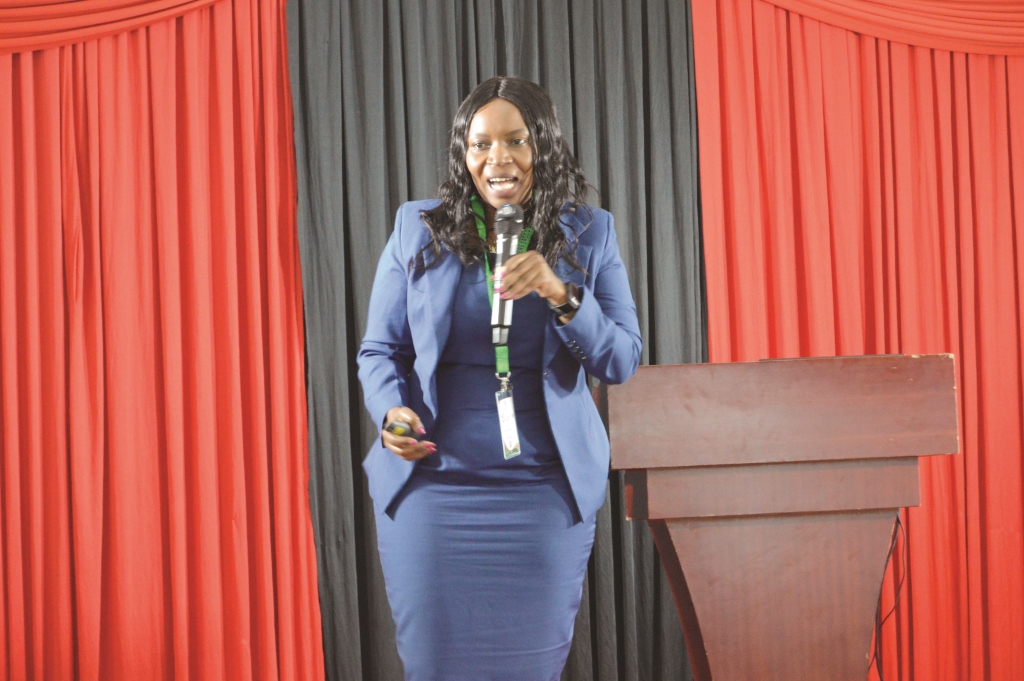
Innovation may be changing the tools of cooperative finance, but the institutions that will define the next era of the cooperative movement are those that understand their members before they understand their products. Speaking during the 15th annual KETSA 15th annual conference, customer experience professional, Esther Marugah (pictured) challenged Sacco leaders to rethink the future of member service, arguing that data, innovation and technology only create value when they are used to solve real human problems.
The future doesn’t wait for comfortable institutions
Long before an institution begins losing members, it begins losing relevance. The warning signs are rarely dramatic. They appear quietly, in a loan application submitted through a competing platform, a young member who chooses a fintech over a Sacco, an entrepreneur who finds faster financing elsewhere, or a loyal customer who slowly disengages because another institution simply understands their needs better. Markets do not stand still, and neither do the people they serve. The organisations that fail are often not those that lacked resources, but those that assumed yesterday’s success would guarantee tomorrow’s relevance.
For Kenya’s Sacco movement, this reality presents both an extraordinary challenge and an even greater opportunity.Few sectors have transformed lives as profoundly as cooperatives have. They have financed education, facilitated home ownership, empowered entrepreneurs, strengthened rural economies and enhanced financial inclusion for millions of Kenyans. Yet the environment in which they now operate bears little resemblance to the one that shaped their early success. Digital technology has altered customer expectations. Artificial intelligence is redefining decision-making. Mobile financial services have made convenience a non-negotiable expectation, while younger generations increasingly judge institutions not by their history, but by the experiences they deliver.
Marugah urged Sacco leaders not to view these shifts as threats, but as an invitation to evolve. Her presentation – ‘ Building the Future-Ready Sacco: Leveraging Innovation, Data andMember-Centric Service ‘ – was less about technology and more about leadership. It challenged boards, executives and managers to recognise that the future belongs not to institutions with the biggest branch networks or the most impressive balance sheets, but to those capable of continuously understanding, anticipating and responding to the changing needs of their members.
As she reminded delegates, “You must adapt or dance.” It was a light-hearted twist on a serious reality: relevance is earned through continuous change.
Data is the new cooperative advantage
For many organisations, data remains an operational necessity, something collected for reports, compliance or audits. Marugah challenged leaders to think far beyond that traditional view. Every transaction, every savings pattern, every loan application and every interaction with a member tells a story. Hidden within that information are insights capable of transforming how Saccos design products, manage risk and build lasting relationships with their members. The institutions that will thrive in the years ahead, she argued, are those that learn to transform information into intelligence.
Understanding members begins with understanding who they are. Age, occupation, income levels, business activities, financial goals and spending behaviour all influence what members expect from their Saccos. Yet many institutions continue to rely on broad, one-size-fits-all approaches that fail to recognise the diversity within their membership.
Marugah encouraged Saccos to embrace meaningful segmentation, enabling them to tailor products and services to different groups rather than assuming every member shares the same priorities. A young professional saving for a first home has different aspirations from a farmer seeking seasonal financing or a small business owner managing cash flow. Recognising those differences allows Saccos to move from simply providing products to solving real financial challenges.
More importantly, she argued that these insights must move beyond management reports and become part of boardroom conversations. Strategic decisions should be informed by a clear understanding of who members are, how their needs are changing and where future opportunities lie. Data, in this sense, is no longer a back-office function; it becomes a strategic asset guiding leadership decisions.
Smarter lending begins long before the loan application
One of the most practical sections of Marugah’s address focused on the role of predictive analytics in strengthening lending decisions.Traditional lending has often depended heavily on financial history and collateral. While these remain important, advances in data analytics now enable institutions to make far more informed decisions. Credit scoring, she explained, provides an indication of the probability that a member may default. However, its purpose should never be to exclude members automatically.
A lower score should instead prompt deeper analysis. Additional collateral, different repayment structures or alternative credit arrangements may enable a member to access financing while protecting the institution from unnecessary risk. Good data should lead to better decisions, not rigid ones.
Equally important is the ability to identify warning signs before losses occur. Members may present convincing proposals for high-value loans, yet underlying behavioural patterns can reveal risks that are not immediately visible. Predictive tools and early warning systems therefore become essential in protecting both the member and the institution.
Fraud detection formed another critical pillar of her presentation. As Saccos accelerate digital transformation, they also expose themselves to increasingly sophisticated forms of financial crime. Marugah challenged leaders to examine whether their know your customer (KYC) systems are sufficiently robust to identify inconsistencies in member identification and digital transactions. Something as simple as recognising different identification serial numbers could prevent significant fraud losses across the sector. Technology, she argued, must therefore strengthen trust, rather than create new vulnerabilities.
Innovation must solve problems, not create headlines
Innovation has become one of the most frequently used words in business today. Yet Marugah cautioned against pursuing innovation for its own sake.An innovation that does not address a genuine need of a member is not innovation at all.
She illustrated this through practical examples that challenged delegates to think beyond conventional financial products. In one Sacco, some members had successfully accumulated valuable assets, only to be forced into selling them when confronted with unexpected medical expenses. The institution responded by integrating medical cover into its product offering, protecting both the member’s wellbeing and the investments they had worked so hard to build. It was a simple but powerful reminder that the best innovations often emerge from understanding the everyday realities of members rather than chasing technological trends.
The same philosophy applies to financial literacy. Many members continue to rely on expensive alternative lenders despite belonging to Saccos offering significantly more affordable financing. This disconnect, Marugah observed, highlights the importance of educating members not only about the available products, but also about making informed financial decisions. Institutions that invest in member education ultimately strengthen their own sustainability while improving the financial wellbeing of those they serve.
Innovation, therefore, extends beyond software or mobile applications. It involves partnerships, education, product redesign and a willingness to rethink how value is created.
Stop selling products. start selling aspirations
Perhaps the most memorable insight from Marugah’s presentation was her challenge to rethink how Saccos market their products.
People do not buy financial products because they are excited about savings accounts or loan facilities. They invest because they dream of something larger, a home, a thriving business, quality education for their children or memorable experiences with loved ones.
To illustrate this, she painted a vivid picture. When property developers market plots of land, they rarely show a piece of empty ground. Instead, they present beautifully designed homes, families enjoying life together and children playing in safe neighbourhoods. They are not selling land; they are selling possibility.
She challenged SACCOs to adopt the same method.Rather than promoting a generic holiday savings account, why not invite members to imagine themselves on the beaches of Mombasa, exploring the Maasai Mara or relaxing in Naivasha? Why not understand where members dream of going and design products that help turn those dreams into reality?
This shift from selling products to enabling aspirations represents one of the most significant opportunities for the cooperative movement. When institutions understand what truly motivates their members, they stop becoming service providers and begin becoming partners in life’s biggest milestones.
Making members feel important
As the presentation progressed, Marugah moved beyond products and technology to the one element she believes will ultimately define future-ready Saccos: people.
She asked delegates to imagine that every member walks into a Sacco wearing an invisible badge bearing four simple words:”Make Me Feel Important.”Those words, she argued, should shape every interaction within the institution.
Making members feel important is reflected in the clarity of branch signage, the comfort of waiting areas, the speed of service, the accessibility of facilities for persons with disabilities and the willingness of staff to listen attentively. It is reflected in celebrating birthdays, recognising loyal savers, acknowledging milestones and creating personalised experiences that demonstrate genuine appreciation for every member.
She recounted the story of a Sacco that recognised a bodaboda rider as one of its most consistent savers, contributing Kshs. 500 every day. The recognition was not about the amount saved , but about reinforcing positive financial behaviour and celebrating commitment wherever it is found. Such moments build emotional connections that no marketing campaign can replicate.
Equally important, she encouraged institutions to stop fearing feedback. Members’ complaints should not be viewed as criticism, but as one of the richest sources of innovation available to any organisation. Listening, acting and continuously improving are the foundations of member-centric leadership.
From customer service to customer intimacy
Marugah concluded by describing what she believes is the next frontier for Saccos.The sub sector has evolved from customer care to customer service, from customer service to customer experience, and now towards customer intimacy. Customer intimacy means understanding members so well that institutions can anticipate their needs before those needs are even expressed. It means using data responsibly to personalise services, predict future requirements and remain relevant in an increasingly competitive market.
She likened the challenge to the story of the Choluteca Bridge, a bridge built to withstand immense forces, yet rendered ineffective when the river it crossed changed course. The lesson for Sacco leaders was unmistakable: institutions can remain financially strong, operationally sound and historically respected, yet still lose relevance if they fail to evolve alongside their members.
The future-ready Sacco, therefore, is not defined by technology alone. It is defined by leaders who use technology with purpose, who see data as a strategic asset rather than an administrative burden and who understand that every innovation must ultimately improve the life of a member.
As Kenya’s cooperative movement continues to navigate an era of unprecedented change, Marugah’s message offers a timely reminder that the greatest competitive advantage will never be found in software, systems or algorithms. It will be found in institutions that never lose sight of the people they exist to serve.
Because in the end, the future will not belong to the organisations that simply digitalise. It will belong to those that adapt, listen, innovate and place their members at the centre of every decision they make.


