


Member centricity, institutional sustainability, a better world to live in, ICT and digitalization anchor the steady growth of top Sacco
By George Gichuki
he Kenya National Police DT Sacco successfully held its 52nd Annual Delegates Meeting (ADM) on 20th February 2026, bringing together delegates, regulators, government representatives, and stakeholders in the co-operative movement in a high-level gathering that highlighted the Sacco’s financial strength, governance maturity, and strategic direction. The leading tier one Sacco ranked third overall in the country by the Sacco Societies Regulatory Authority (SASRA) has very humble roots. It was registered in November 1972 and commenced operations in June 1973. According to information provided in ‘Ties That Built a Legacy,’ a book which has vividly captured the Sacco’s half century journey: ‘Kenya National Police DT Sacco was founded in 1972, to encourage saving by police officers and to provide small loans for financing micro-projects with a view to uplifting their living standards.’ In its early days, the Sacco had a skeleton staff of two who were serving six hundred and ninety members. The services of the two staff members were complemented by members of the managing committee who offered their expertise in various key areas. The Sacco was therefore able to overcome hurdles in those trying moments.
In 1986, the Sacco started employing professionally qualified staff. Consequently, its fortunes started changing. The book records that there was marked improvement in service delivery and harnessing of resources when the professional staff came on board. In a nutshell, the National Chairman, Mr. David Mategwa, says in his message as recorded in the book: ‘The start of the Sacco’s journey was expectedly slow and there were many challenges in its first decade that almost pushed it under. However, owing to the discipline, commitment and dedication of its leadership, it not only survived but also embarked on an upward growth trajectory in all the parameters.”
By the same token, the Chief Executive Officer, Mr. Solomon Atsiaya adds: “Ties That Built a Legacy aptly captures the evolution of Police Sacco, recording its transformation through the first five decades and presenting a story of how it weathered the storms to become one of the top Saccos in Kenya in terms of asset base.” During its trying moments according to the CEO, the Sacco demonstrated a collective spirit of selflessness, dedication, commitment and discipline and it was therefore able to weather the storm. The book was launched during the 52nd ADM.
2025 financial year results
The 52nd ADM, one of the most anticipated events in the Sacco’s annual calendar, reviewed its performance in the 2025 financial year. The long-term vision of the Sacco, anchored on sustainability, digital transformation, and enhanced member welfare was also highlighted. At the centre of the proceedings was the National Chairman of the Board, Mr. Mategwa, whose report painted the picture of a forward looking Sacco that has steadily evolved from a small lender into a modern financial institution, offering innovative products and services , driven largely by technology. Having opened its common bond in 2018, the tier one Sacco serves over 76,280 members across the country.
In his address during the ADM, the National Chairman reaffirmed the Sacco’s commitment to stability and long-term value creation, noting that it had recorded strong growth across its key financial indicators despite a challenging operating environment. In that regard, its total assets grew by 11.1% – from Kshs. 59.8 billion in 2024 to Kshs. 66.4 billion in 2025. Additionally, the non-withdrawable deposits increased by 8% – from Kshs. 31.1 billion in 2024, to Kshs. 33.6 billion in 2025. The loans and advances grew by 10.1% – from Kshs. 50.4 billion in 2024, to Kshs. 55.3 billion in 2025. Significantly, the revenue of the Sacco grew from Kshs. 9.9 billion in 2024 to Kshs. 10.7 billion in 2025; equivalent to 8%. Finally, the core capital strengthened by 12.3%; rising from Kshs. 19.8 billion in 2024, to Kshs. 22.2 billion in 2025.
Against this strong financial performance, members were paid dividends on their share capital at a rate of 17%, amounting to Kshs. 624.3 million, and interest on deposits at a rate of 11%, amounting to Kshs. 3.5 billion. The gross total in 2025 was Kshs. 4.1 billion, in comparison to Kshs. 3.9 billion in 2024; an increase of 6.6%.
The National Chairman emphasized that these results were not accidental but a reflection of disciplined governance and members’ confidence in the institution. “Despite a challenging business environment, the Sacco recorded notable achievements and continues to lay a strong foundation for growth, resilience and lasting value for our members and the wider community,” he told the delegates.
In the 2025 financial year, the Kenya Police Investment Co-operative also recorded growth across all key indicators. To start with, its membership grew by 2.3 %, from 7,210 in 2024 to 7,371 in 2025, while the total assets increased by 66.9%; from Kshs. 498 million to Kshs. 831 million. This growth was driven largely by new gated community projects in Juja, Kiserian and Eldoret. Demonstrating this growth further, members’ deposits rose by 10.1%, from Kshs.155 million to Kshs. 170 million, while the share capital rose by 2.8% – from Kshs. 121 million to Kshs. 124 million, and core capital by 17.7% – from Kshs. 251 million to Kshs. 296 million. Finally, the total revenue grew by 179.6% – from Kshs. 106 million to Kshs. 297 million. “This performance reflects the Co-operative’s financial resilience, supported by enhanced marketing and disciplined implementation of the 2025-2029 strategic plan,” said the National Chairman in his presentation.
Corporate governance, stability and institutional credibility
Due to the Sacco’s steadfast commitment to good governance and professional practices the National Chairman further said, in 2025, it was rated the second best managed nationally, among other top awards during the Ushirika Day celebrations. It also carried out a nationwide financial literacy programme, targeting 11,355 members as well as its top savers. “In 2026, these initiatives will continue – including the regional best savers training, international training for the top ten savers, and ongoing local and international learning for the board, management and staff,” he reaffirmed.
As a reflection of the Sacco’s strong capital, liquidity and asset quality, in April 2025, GCR Ratings reaffirmed its A-(KE) long-term and A2 (KE) short term ratings with a stable outlook. “Further building on ISO 9001: 2015 certification, the Society also commenced integration of quality management, information security management (ISO 27001), and business continuity management (ISO 22301) systems, strengthening resilience, operational excellence and stakeholder confidence for sustainable growth in a digital environment,” said the National Chairman.
Strategic plan and future direction
The Kenya National Police DT Sacco has a five year (2025–2029) strategic plan. It is built on four core pillars: member centricity, institutional sustainability, a better world to live in, ICT and digitilization. A flagship initiative within this plan is the proposed acquisition of property for a new headquarters, expected to be implemented in 2026 once approved by the delegates.
The National Chairman also noted that members contribute monthly to the UBF fund, which covers deposits, loans and benefits in the event of death, ensuring continuity and financial protection for families. Nevertheless, these collections have not met the set target, and the Sacco is forced to cover the short fall. To address this challenge, the National Chairman noted that this policy will be reviewed in order to ensure sustainable member funding.
Technology, community impact and transformation
The Sacco reported significant investment in technology as a strategic pillar and key driver of business operations. In 2025, it undertook significant technological enhancements aimed at improving service efficiency, reliability, and accessibility for members across multiple transaction channels including: deposits, withdrawals, loan disbursements and repayments. To this end, Mtawi platform remains the flagship digital channel. The National Chairman told the delegates that the Sacco is planning to operationalize additional transaction channels in the first quarter of 2026 as part of its ongoing digital transformation agenda.
Beyond financial services, Kenya National Police DT Sacco is committed to corporate social investment. In 2025 for instance, thirty seven out of forty three students in the sponsored education and mentorship programme who sat for KCSE qualified for university admission. Additionally, a modern gymnasium constructed at the National Police College Main Campus in Kiganjo was commissioned, reinforcing the Sacco’s community impact. Moreover, the Sacco constructed a saluting dais at the Embakasi B Campus. This facility is now awaiting commissioning.
A Cooperative Model of Wealth Creation
The ADM highlighted a broader trend within Kenya’s cooperative movement. Saccos are evolving beyond traditional savings institutions into fully-fledged financial institutions offering stability, structured credit access and long-term wealth creation.
For Kenya National Police DT Sacco, the ADM reaffirmed a central message: cooperative finance remains one of the most reliable financial pathways for disciplined saving, affordable credit and empowerment of members.
As the giant Sacco moves into its next strategic phase, its leadership emphasized sustainability, digital innovation and member prosperity as the guiding priorities, positioning it not just as a financial institution, but as a long-term economic partner for its members.
A strong financial institution
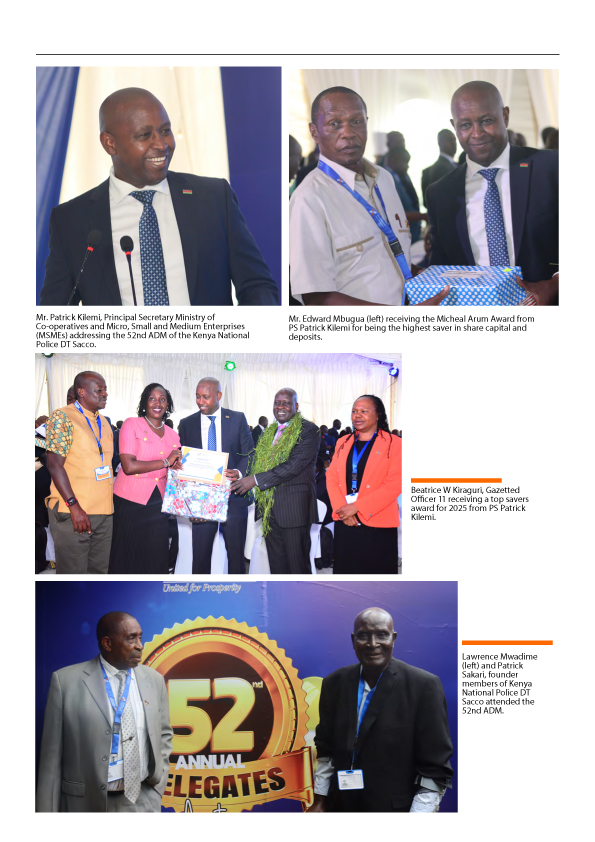
The Principal Secretary in the Ministry of Co-operatives and Micro, Small and Medium Enterprises (MSMEs) , Mr. Patrick Kilemi, represented the Cabinet Secretary of the said ministry, Hon. Wycliffe Oparanya as the chief guest in the ADM. In a speech that was read on his behalf by the PS, Hon. Oparanya noted that Kenya National Police DT Sacco is a strong financial institution that is anchored on trust, service delivery and financial discipline. “Over the years, you have demonstrated that our well managed co-operatives can uplift members, support families and strengthen national development,” said Hon. Oparanya.
He further said that Saccos in Kenya are a financial backbone of households, workers, farmers, youth and many people in the MSME sector. Against this background, they play a pivotal role in the success of Kenya government’s bottom-up economic transformation agenda, financial inclusion and economic growth. He lauded the board, management, staff and members of the Kenya National Police DT Sacco for delivering a strong performance in 2025, despite the challenging macroeconomic environment characterized by a high cost of living, currency pressure and tight liquidity. “Your Sacco recorded notable growth across all the key financial indicators; reinforcing its position among the leading deposit taking Saccos in Kenya and indeed across Africa,” said the CS adding that this demonstrates that the Sacco has a strong governance and management structures , and members have confidence in it.
Hon. Oparanya further noted that institutions that deliberately invest in strong governance strictures will invariably outlast the ones that do not do so. To that end, he said, Kenya National Police DT Sacco stands out as a model of what disciplined governance, strong capitalization and professional management can achieve. “As we implement reforms in the Sacco sub-sector, institutions such as yours will play a critical role in setting the standards and mentoring the wider co-operative movement,” he emphasized.
Proposed reforms in the Sacco sub sector
On 16th April 2025, the CS appointed a committee of experts to undertake a comprehensive review of the Sacco Societies Act 2008. “The review was necessitated by the need to align our regulatory framework with the current realities within the sub-sector, emerging risks, technology changes and global trends in the co-operative movement and financial sector,” he said. On February 10, 2026, a report was presented to the President by a multi-agency delegation and the committee of experts. “This landmark report marks a significant milestone in our collective effort to build a Sacco ecosystem that is resilient, transparent, well governed and fit for the future,” the CS told the delegates.
This report, emphasized the CS sets out far reaching reforms that will fundamentally strengthen the co-operative finance ecosystem. Key among these reforms is strengthening of SASRA and expansion of its regulatory mandate to cover big and small Saccos. This will effectively protect the deposits of members. In a nutshell, the reforms will focus on: modernizing the Sacco operations, strengthening governance, enhancing digital integration and safeguarding members’ savings.
One of the reforms proposed in this report is the establishment of a Sacco stabilization fund to support viable Saccos which may be facing temporary financial distress. Secondly is the creation of a deposit guarantee fund to enhance the protection of members’ savings. Thirdly, there is a proposal to develop a registry and clean- up of dormant and non-compliant Saccos. Other proposed reforms include: development and enforcement of a governance charter for Saccos dubbed ‘Mwangaza’ – a baseline government framework for all Saccos, increase in the minimum period for members’ registration, adoption of the delegate system of representation in general meetings for Saccos with over five thousand members, strengthening of digital engagement for members, appointment of independent directors in the Sacco boards, establishment of robust technical financial oversight structures among Saccos in line with the global best practice as well as progressive transition to the internationally recognized credit union standards.
The committee has also proposed that Saccos should be classified into large, medium, and small categories for appropriate regulation and supervision. Finally, there is a proposal to establish a central clearing house framework to enhance the Sacco sub-sector’s liquidity management and operational efficiency.
The CS pointed out that the Sacco sub-sector must confront the structural realities. For instance, many small back office services activities (BOSA) Saccos in the country are inactive and they exist only on paper. They are neither financially stable nor operationally viable. Market driven solutions – including mergers and acquisitions as well as consolidations – should therefore be developed to address that challenge. “Stronger and well capitalized Saccos will be better positioned to serve members efficiently, manage risk effectively and remain competitive in an evolving financial landscape,” he said. “We are encouraging Saccos to position themselves for emerging opportunities in climate finance, green energy, sustainable agriculture and carbon markets,” he added.
Community impact and social investment
Beyond financial services, the Sacco highlighted its social responsibility initiatives. During 2025, it sponsored education and mentorship programmes for students. Additionally, it supported infrastructure development at the National Police College, Kiganjo, including construction of a modern gymnasium. The Sacco emphasized that cooperative institutions must serve both its members and the society at large, aligning financial services with community development.
A half-century legacy moving forward
The ADM concluded with a clear message: Kenya National Police DT Sacco has evolved into a modern, regulated financial institution while preserving its cooperative identity. Most importantly, it is committed to protecting members’ savings, expanding access to credit, and building long-term economic security.


