



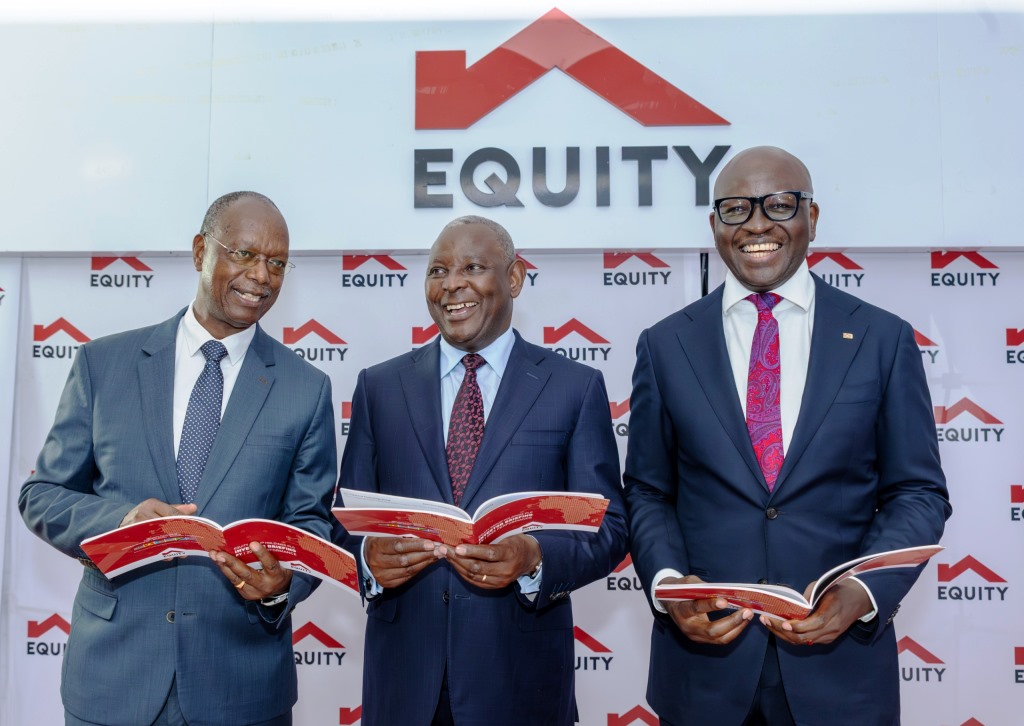
Equity Group has posted a 55% increase in profit after tax of Kshs. 75.5 billion in the 2025 financial year, up from Kshs. 48.8 billion in 2024. The performance reflects the group’s successful business transformation, diversified revenue growth, enhanced efficiency, and robust regional contributions. The lender’s balance sheet expanded by 9% to Kshs. 1.97 trillion in comparison to Kshs. 1.8 trillion in 2024. Additionally, the customer deposits rose by 4% to Kshs, 1.46 trillion ( compared to Kshs. 1.40 trillion in 2024) , while the net loans increased by 8% to Kshs. 882.5 billion up from Kshs. 819.2 billion in 2024. Significantly, the group closed the year with 22.4 million customer accounts, supported by a strong regional distribution and digital ecosystem.
Strong revenue performance saw net interest income grow by 17% to Kshs. 126.9 billion, non‑funded income rise 7% to Kshs. 90.8 billion, while the total income increased by 12% to Kshs. 217.7 billion compared to Kshs. 193.8 billion in 2024. The lender’s operational efficiency improved significantly, with the cost‑to‑income ratio falling to 51.0% from 58.2%. This was driven by continued migration to self‑service channels, productivity gains, and tighter cost discipline supported by shared services within the group as well as digital infrastructure. In the same vein, over 98% of the lender’s customers’ transactions were conducted outside branches, with 88.4% processed through digital channels. This reflects continued demand for digital services with increased investment in customer‑centric digital infrastructure. Loan loss provisions declined by 28%, while non- performing loans coverage strengthened to 67.7%, supported by a reduced cost of risk of 1.7%.
Strategic transformation
Commenting on these results, Equity Group Managing Director and CEO Dr. James Mwangi said they demonstrate the strength of the group’s strategic transformation, driven by diversified revenue streams, improved efficiency and growing contributions from regional subsidiaries: “The 2025 performance reflects the success of our deliberate transformation into a diversified, regional financial services group. We delivered strong profit growth by expanding and deepening our income streams, improving efficiency across the franchise, and strengthening the quality of our balance sheet. Importantly, our regional subsidiaries now contribute about half of our banking profitability, demonstrating the value of our pan-African footprint and the resilience that comes from diversification.”
On the back of this performance, the directors have recommended a dividend of Kshs. 5.75 Per share, up from Kshs. 4.25. This amounts to a payout of Kshs. 21.7 billion, compared to Kshs 16 billion in 2024, representing a 35.3% growth in dividends.
Equity Bank Kenya, regional operations and Equity Insurance
Equity Bank Kenya reported a 63% rise in profit after tax to Kshs. 39.2 billion, compared to Kshs. 24.1 billion in 2024. This was driven by a 28% increase in net interest income and a 37% reduction in interest expense. Additionally, the lender’s shareholders’ funds grew by 11% to Kshs. 136.2 billion, while returns on assets and equity strengthened to 3.9% from 2.4% and 26.8% from 20.2%, respectively. The performance reinforces Equity Bank Kenya’s leadership in supporting enterprise growth, with the bank having been recognized at the Kenya Bankers Association Sustainable Finance Initiative (KBA SFI) Awards as the best bank for MSME financing.
The regional operations accounted for about half of the group’s profitability in the 2025 financial year, underscoring Equity’s emergence as a pan-African financial services group. In the DRC, profit after tax rose by 58% to Kshs. 24.7 billion, supported by 17% loan growth. Additionally, Uganda’s profit after tax jumped 500% to Kshs. 3.6 billion, while Rwanda posted a profit after tax of Kshs. 5.4 billion, with total assets up 5% and the loan book expanding 22%. Tanzania’s profit after tax grew by 125% to Kshs. 2.7 billion, alongside a 75% increase in shareholders’ funds. Overall, subsidiaries contributed 51% of banking profit before tax , and 48% of banking profit after tax.
Equity Insurance continued its strong expansion, driven by newly acquired life, general, and health underwriting licenses. Gross written premiums rose by 75% to Kshs. 9.17 billion, delivering profit before tax growth of 36% to Kshs 2.0 billion, and a 150% rise in insurance revenue to Kshs 3.57 billion. All subsidiaries delivered solid growth. To start with, Equity Life Assurance delivered a profit before tax of Kshs. 1.77 billion. It is currently serving 6.9 million customers with 19.2 million policies issued since inception. Secondly, Equity General Insurance reported Kshs 1.79 billion in gross written premiums and Kshs 199 million in profit before tax in its first year of operations, while Equity Health Insurance reported Gross Written Premium of Kshs. 20 million and Kshs. 40 million in profit before tax in its first four months of operations.
Strategic measures
The group’s strong performance also reflects its intentional focus on anchoring a refreshed corporate culture and strengthening staff productivity to deliver a consistently delightful customer experience. By institutionalizing robust internal controls, elevating performance standards, and embedding disciplined, data‑driven execution across all teams, the group has enhanced operational efficiency, strengthened risk management, and deepened customer‑centricity.
These strategic measures, combined with a culture of accountability, agility, and service excellence, continue to position the group to deliver superior outcomes across all markets.
Equity Bank was named the Best Regional Bank in East Africa and retained its position as Kenya’s most valuable brand in 2025, reaffirming the group’s regional leadership and commitment to financial inclusion and socio‑economic transformation. Beyond lending, the group is strengthening market linkages for small and medium enterprises (SMEs) by enabling cross-border trade through its regional footprint and integrated digital payments and transaction-banking capabilities. By and large, this is helping businesses access new customers, suppliers and growth opportunities across the region.
Dr. Mwangi added that the Group will continue to execute its 2030 strategy anchored in the Africa Recovery and Resilience Plan (ARRP), leveraging next‑generation digital and AI‑enabled capabilities to scale impact, deepen inclusion and accelerate growth across the continent: “Our focus is to build a future-ready institution that is scalable, secure and impact-led. Through ARRP, we are investing in next-generation digital and AI-enabled capabilities that enhance customer experience, strengthen risk management and lower the cost-to-serve, while extending access to affordable credit, insurance and investment solutions. As we progress toward our 2030 ambitions, we are evolving beyond traditional banking into a transformation finance institution that mobilizes capital, connects ecosystems and accelerates inclusive, sustainable prosperity across Africa,” he said.
Equity Group’s 2030 strategy positions the organization for transformative, continent‑wide growth. Anchored in the ARRP, the group aims to operate in fifteen countries and serve one hundred million customers by 2030. With strong governance, upgrades include next‑generation digital, AI‑enabled systems, and the launch of innovative applications supported by a modern go‑to‑market model. These developments drive more effective service to diverse customer segments while building a culture of client centricity, agility, and innovation. Through blended finance, strategic partnerships, and ecosystem development, Equity is evolving from a traditional bank into a transformation finance institution – mobilizing private capital to drive inclusive, sustainable prosperity across Africa.


