


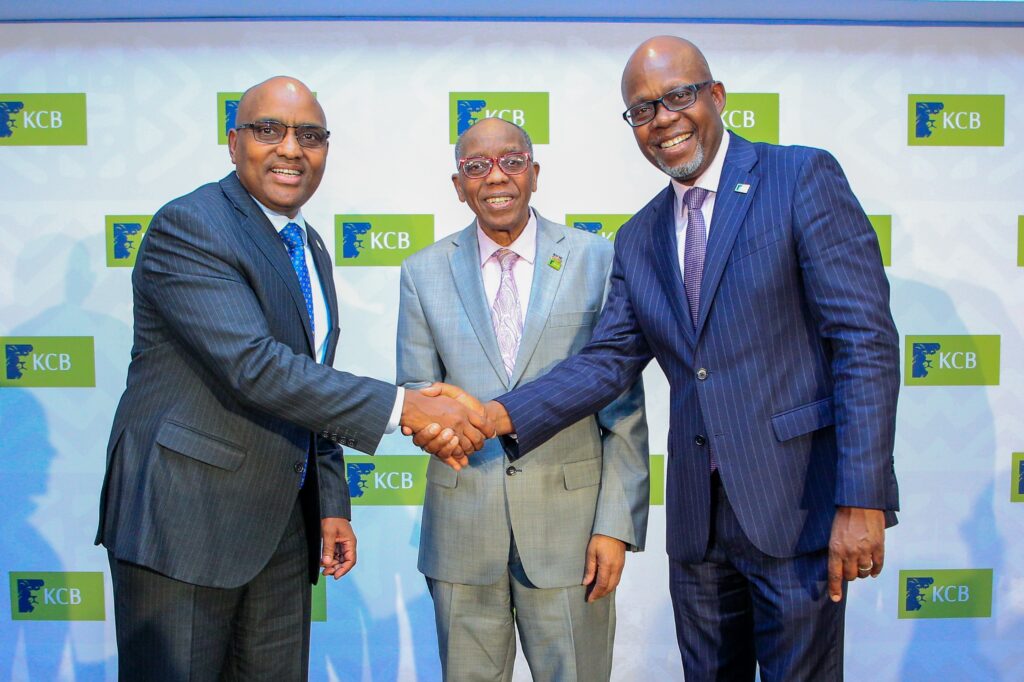
Stronger regional subsidiary contributions, rising digital transaction volumes and improved asset quality underpin the lender’s nine-month performance, as total assets cross the KSh2.4 trillion mark
KCB Group PLC has posted a 24% increase in profit after tax to KSh58.6 billion for the nine months ended September 30, 2026, supported by stronger income generation, increased lending activity and improved operating efficiency across its businesses.
The Group’s earnings per share rose by 24.3% to KSh17.80, while total assets expanded by 15.4% to KSh2.4 trillion, reflecting growth in customer deposits and lending. Customer deposits increased by 15% to KSh1.8 trillion, while gross loans grew by 11% to KSh1.4 trillion, pointing to sustained demand for credit across its markets.
The performance underscores the strength of the Group’s diversified financial services model, with its Kenyan banking business continuing to anchor earnings while regional subsidiaries make an increasingly significant contribution to the overall results.
Regional Subsidiaries Strengthen Group Performance
KCB Bank Kenya recorded a 20.7% increase in profit after tax to KSh40.8 billion, with its balance sheet growing by 13% to KSh1.6 trillion. Meanwhile, subsidiaries outside Kenya registered a combined profit after tax of KSh19.6 billion, representing a 24.3% increase. These businesses accounted for 33.4% of the Group’s net profit and 33% of its total balance sheet.
Growth across Burundi, South Sudan and Uganda, alongside improved performance from KCB Investment Bank and KCB Corporate Trustee Services, reinforced the contribution of regional operations to the Group’s financial performance.
Digital Transactions Drive Non-Funded Income
The Group’s revenue growth was equally notable. Total income increased by 12.3% to KSh167.8 billion from KSh149.4 billion in the corresponding period last year. Funded income, largely associated with lending and interest-earning assets, rose by 8.2% to KSh112.9 billion, while non-funded income grew by a stronger 21.8% to KSh54.9 billion.
The expansion in non-funded income reflects the growing contribution of digital transactions and alternative banking services to the Group’s earnings. Mobile loan disbursements increased by 26% to KSh492 billion during the period, equivalent to approximately KSh1.8 billion daily. Foreign exchange income also recorded a 65.1% increase, supported by higher transaction volumes, particularly from Trust Merchant Bank (TMB).
The Group further benefited from additional services introduced through its unified mobile application, including money market funds, PesaLink and bill payment solutions. These developments point to the increasing importance of transaction-based services in complementing traditional interest income.
Importantly, the growth in income was accompanied by improved cost efficiency. KCB’s cost-to-income ratio declined to 43.7% from 46.2% in the corresponding period of 2025, as revenue growth outpaced the increase in operating expenditure. Operating costs rose by 6.1%, reflecting continued investment in technology and costs associated with business and branch expansion.
Asset Quality Improves as Non-Performing Loans Decline
Asset quality also showed improvement. Loan loss provisions declined by 9.1% year-on-year to KSh16.6 billion, while gross non-performing loans fell by 17.1% to KSh184.1 billion from KSh222.1 billion. Consequently, the Group’s non-performing loan ratio improved to 13.3% from 17.8% a year earlier. Within the Kenyan banking business, the stock of non-performing loans declined by 19.5%, equivalent to KSh39.3 billion.
The improvement comes alongside continued lending to priority sectors, particularly micro, small and medium-sized enterprises (MSMEs). The Group reported increased loan disbursements to MSMEs, especially through KCB Bank Kenya, TMB and BPR. Agriculture, energy and water recorded the highest activity across the overall loan book, while households, real estate and manufacturing accounted for the largest components.
Strong Capital Position Provides Room for Expansion
The Group also maintained a strong capital position, with its core capital to total risk-weighted assets ratio standing at 18%, above the statutory minimum of 10.5%. Its total capital to risk-weighted assets ratio stood at 21.1%, exceeding the regulatory threshold of 14.5%. Return on equity was 22.1%, while total equity attributable to shareholders increased by 17.3% to KSh362 billion.
Commenting on the results, KCB Group Chief Executive Officer Paul Russo said investments in technology, customer experience and regional business capabilities continued to translate into stronger performance. He also highlighted the Group’s focus on leveraging its scale and distribution network to support customers, particularly MSMEs, as drivers of sustainable economic growth.
Sustainability and Regional Expansion Remain Key Priorities
Beyond its core banking operations, the Group continued to advance its sustainability and financial inclusion agenda. During the first nine months of 2026, it disbursed KSh20.8 billion in green loans across corporate and retail segments and screened loans worth KSh451 billion under its Environmental and Social Due Diligence frameworks.
Its regional expansion strategy also gained momentum following an increase in its shareholding in Trust Merchant Bank in the Democratic Republic of Congo from 85% to 98% in September. The move strengthens its position in the market and provides greater flexibility to support the subsidiary’s growth.
KCB Group Chairman Dr. Joseph Kinyua said the Group’s capital buffers provided sufficient capacity to absorb potential economic shocks, support expansion and sustain lending across its markets. He added that the priority remained strengthening governance, protecting financial stability and translating investments into sustainable shareholder returns and meaningful community impact.
With nine-month profit already reaching KSh58.6 billion, the Group enters the final quarter of 2026 with stronger earnings, an expanded balance sheet and improved asset quality. Its ability to sustain this momentum will depend on maintaining disciplined lending, managing credit risk and converting its investments in technology and regional operations into continued growth.


