


Savings and credit co-operative giant records strong performance in the 2025 financial year as members receive hefty dividends and interest rebates
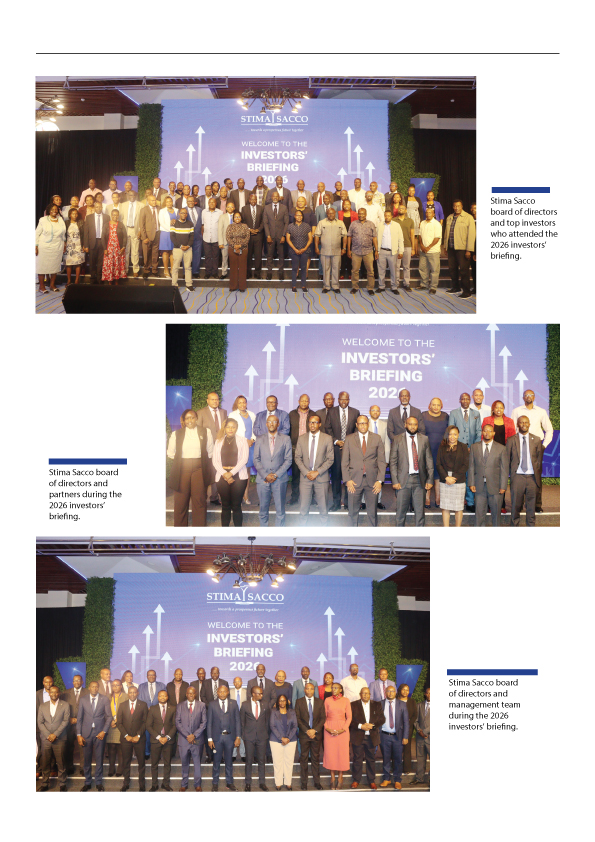
Stima Sacco has reinforced its position as one of Kenya’s most formidable financial institutions after registering outstanding performance in the 2025 financial year, and outlining an ambitious strategy focused on digital transformation, sustainability and long-term institutional resilience. The leadership of the tier one Sacco presented these results during an investors’ briefing at the Movenpick Hotel – Nairobi.
The high-level session brought together top savers, investors, regulators, institutional partners and members of the media to review the Sacco’s performance and its strategic direction following the Annual General Meeting (AGM) held earlier in March. With total assets now standing at Kshs. 75.3 billion, the Sacco continues to demonstrate the strength and resilience of Kenya’s cooperative financial model.
Financial highlights signal strong institutional momentum
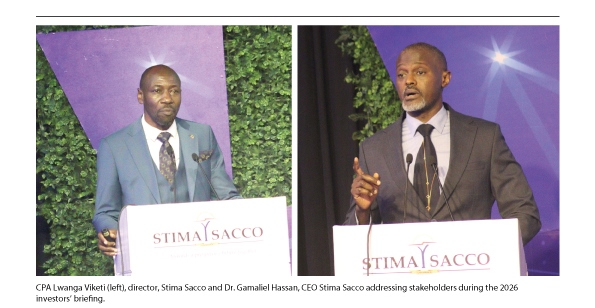
Opening the financial review during the investors’ briefing, CPA Lwanga Viketi, director, Stima Sacco and a member of the board’s finance committee highlighted the Sacco’s strong year-on-year growth across its key financial indicators, noting that the results reflected both prudent financial management and overwhelming confidence from members. He noted that membership increased from 220,650 in 2024 to 241,324 in 2025, representing a 9.4 percent growth, as more Kenyans continued to join the lender for accessible and reliable financial services.
The Sacco also recorded strong expansion in its core financial base, with member deposits rising from Kshs. 46.7 billion in 2024 to Kshs. 52.2 billion in 2025, marking an 11.8 percent increase and reinforcing the institution’s stable savings culture. Lending activity remained robust as well, with loan advances growing from Kshs. 50.2 billion to KShs. 52.5 billion, reflecting a 4.6 percent increase driven by continued demand for credit among members. Overall institutional growth remained strong, with total assets rising significantly from Kshs. 66.4 billion to Kshs. 75.3 billion, representing a 13.4 percent increase, while total revenue improved from Kshs. 10.3 billion to Kshs. 10.8 billion, a 4.9 percent rise despite the challenging macroeconomic environment experienced during the year.
CPA Viketi further noted that the Sacco’s strong performance translated into improved returns for members. Interest rebates rose from Kshs. 3.9 billion to Kshs. 4.3 billion, representing a 10.3 percent increase, while dividend payouts increased from Kshs. 638.1 million to Kshs. 788.7million, registering a notable 23.6 percent growth. This underscored the Sacco’s commitment to delivering value to its members while maintaining sustainable institutional growth.
Record returns for members
Building on the strong financial performance, CPA Viketi said this ultimately translated into tangible financial benefits for the members. The AGM approved a combined payout of Kshs. 5.1 billion, an increase from Kshs. 4.6 billion in the previous year. The payout included a 16 percent dividend on share capital and an 11 percent interest rebate on non-withdrawable deposits, returns that CPA Viketi said remain among the most competitive within Kenya’s financial sector.
He further noted that the payout has already injected billions of shillings back into the economy, with members across the country accessing their returns through the Sacco’s branch network as well as its growing digital platforms. According to CPA Viketi, the strong returns reflect the institution’s continued commitment to rewarding members while maintaining prudent financial management and long-term sustainability.
Strategic focus following golden jubilee
CPA Viketi also noted that the year under review marked an important transition period for the Sacco following its golden jubilee celebrations in 2024, which commemorated five decades of operations and steady growth. In the period that followed, the institution focused on consolidating the gains achieved over the past five decades while accelerating the implementation of its 2025–2029 strategic plan.
He explained that the strategy is anchored on strengthening member and business development, enhancing operational and service excellence, safeguarding financial sustainability and investing in people as well as organizational culture. These pillars, he said, guide the Sacco’s long-term vision of building a resilient cooperative institution capable of continuously delivering value to its members while maintaining strong governance, operational efficiency and financial stability.
Digital transformation accelerates
The Chief Executive officer, Dr. Gamaliel Hassan, while addressing stakeholders during the investors’ briefing, highlighted digital transformation as one of the most significant drivers of the lender’s growth. He noted that the Sacco has made substantial progress in expanding its digital banking ecosystem, enabling members to access products and services more efficiently and conveniently.
Additionally, transaction volumes have grown significantly over the past two years, increasing from Kshs. 33.9 billion in 2023 to Kshs. 51.4 billion in 2025, representing a 51.5 percent rise. Currently, more than 93 percent of the Sacco’s transactions are conducted through digital channels, including mobile banking and internet platforms, reflecting a fundamental shift in how members interact with it.
The transition to digital platforms has not only improved accessibility for members, but has also reduced congestion across physical branches while enabling faster and more efficient service delivery. The Sacco has also strengthened its digital loan systems, enabling members to access services such as online salary advance applications, automated guarantor notifications and loan statements through mobile platforms. These improvements have enhanced convenience for members while reinforcing stronger credit management processes within the institution.
Strengthening digital infrastructure
As digital adoption continues to grow, the Sacco has placed significant emphasis on strengthening the technological backbone supporting its operations. Following a core banking system post-implementation review, more than 90 percent of the recommended system enhancements have already been implemented.
These upgrades have improved workflow automation across departments, strengthened reporting capabilities and enhanced management oversight, allowing the institution to operate more efficiently while maintaining high service standards.
At the same time, cyber security has become an increasingly critical area of focus. Despite the rapid expansion of digital services, the Sacco reported zero financial losses from cyber-related incidents during the year under review. Continuous system monitoring, enhanced threat detection capabilities and strengthened digital safeguards have helped in protecting members’ data while reinforcing confidence in the Sacco’s digital platforms.
Diversifying revenue streams
Beyond strengthening its digital ecosystem, the Sacco has also been actively working to broaden its revenue base in order to reduce reliance on interest income generated from lending activities.
While interest from the loan book still accounts for approximately 78 percent of total income, investment income has steadily grown and now contributes more than 18 percent of its overall revenue. As part of this diversification strategy, the Sacco has invested over Kshs. 6 billion in long-term government securities, providing a stable income buffer while strengthening financial resilience. An additional Kshs. 7 billion has been placed with tier one and tier two banks, generating investment returns while reinforcing institutional partnerships within the financial sector.
A significant milestone was also achieved through the transformation of the Sacco’s insurance subsidiary, Mpawa Insurance, from an insurance agency into a fully licensed insurance brokerage. The brokerage firm has already generated more than Kshs. 600 million in premiums and is expected to play a pivotal role in expanding non-funded income streams for the institution.
Affordable housing and green financing
The Sacco is also increasingly positioning itself as a key participant in financing national development priorities, particularly in areas such as housing and sustainable investments.
Through its partnership with the Kenya Mortgage Refinance Company, the Sacco has already issued Kshs. 1.2 billion in affordable housing loans, helping members to access home ownership opportunities under Kenya’s broader housing agenda.
Looking ahead, the institution is also preparing to expand its role in green financing, supporting environmentally sustainable investments among its membership base. Approval has already been secured for a green savings product, while a green loan product is currently under preparation pending regulatory clearance.
These initiatives form part of the Sacco’s long-term strategy of aligning financial services with sustainability and climate-responsive economic activities.
Sustainability and responsible finance
Sustainability continues to play a central role in the Sacco’s operational philosophy. Guided by the theme “Sustainability Rewritten: People, Planet and Purpose,” the institution has been integrating environmental and social considerations more deeply into its financial and operational frameworks.
An Environmental and Social Management System (ESMS) has been introduced to strengthen responsible lending practices across the organization. This framework includes environmental risk screening and climate vulnerability assessments for properties used as collateral, ensuring that lending decisions take into account both financial and environmental risks.
Digitilization initiatives are also contributing to sustainability objectives by reducing operational waste and limiting paper usage while simultaneously improving efficiency and service delivery for members.

Governance and institutional strength
The National Chairman Dr. Joseph Siror emphasized that strong governance has remained a defining pillar of the Sacco’s long-term stability and continued growth. While addressing stakeholders, he noted that the institution’s ability to deliver consistent financial performance is closely tied to the strength of its governance structures and the discipline with which oversight responsibilities are exercised.
“Strong governance remains the cornerstone of our institutional strength,” he observed, noting that the Sacco has consistently invested in strengthening its governance frameworks in order to maintain transparency, accountability and responsible stewardship of members’ resources. As part of this commitment, the institution regularly conducts governance audits, board evaluations and performance reviews aimed at strengthening oversight and reinforcing best practice standards within its leadership structures.
Oversight has also been expanded across several critical risk areas as the Sacco continues to grow in scale and complexity. Particular attention has been placed on maintaining strong credit quality, enhancing cyber security safeguards, ensuring regulatory compliance and addressing emerging climate-related financial risks. According to the National Chairman, these measures are essential to safeguarding institutional resilience while ensuring the Sacco remains well positioned to navigate an evolving financial and regulatory landscape.
Investing in people and leadership
Beyond financial performance, Stima Sacco continues to place significant emphasis on investing in its people as a core component of long-term institutional sustainability. The tier one Sacco has expanded its internal training and development programes in recent years, strengthening technical expertise across departments while enabling teams to drive innovation more efficiently and reduce reliance on external consultants.
Leadership development has also remained a key priority. The Sacco continues to expand its Stima Malkia initiative, a programme designed to mentor and empower women within the organization while nurturing future leaders within the cooperative movement. Through structured mentorship, professional development opportunities and leadership training, the initiative seeks to build a strong and inclusive leadership pipeline capable of guiding the institution into its next phase of growth.
These efforts reflect a broader understanding that institutional strength is not only defined by financial performance, but also by the capacity of its people to lead, innovate and sustain the lender’s mission over the long term.

Sacco sub sector reforms
During the briefing, Dr. Hassan also addressed the broader reforms currently shaping Kenya’s Sacco sub-sector. Drawing from his role in a committee of experts tasked with reviewing regulatory frameworks governing Saccos in Kenya, he outlined several proposals that are under discussion as policymakers seek to strengthen the resilience and credibility of the sub- sector.
Among the key reforms being considered is the establishment of a central liquidity facility, which would enable inter-Sacco lending and provide institutions with greater flexibility in managing short-term liquidity pressures. Discussions are also underway around the creation of a deposit guarantee fund, potentially supported by the Kenya Deposit Insurance Corporation, which would provide an additional layer of protection for members’ deposits and enhance public confidence in cooperative financial institutions.
Another area of focus involves the development of shared technology platforms that would allow smaller Saccos to access modern digital infrastructure without bearing the full cost of individual system investments. According to Dr. Hassan, these reforms have the potential to significantly strengthen the cooperative ecosystem and elevate the sector’s standing within Kenya’s financial services landscape. “These reforms will strengthen the sub- sector and ensure that a shilling in a Sacco carries the same level of confidence as a shilling in a bank,” he noted.
Outlook for 2026
Looking ahead, Stima Sacco anticipates that the year ahead will present both new opportunities and emerging challenges. The leadership acknowledged that global developments such as oil price volatility and ongoing geopolitical tensions may continue to influence financial markets and the broader economic environment.
Despite these uncertainties, the Sacco’s leadership remains confident in the institution’s resilience and its ability to adapt to shifting economic conditions while continuing to deliver value to its members. The strategic focus for the coming year will centre on deepening digital financial services, expanding into green financing solutions and strengthening the Sacco’s investment portfolio to ensure sustainable income streams.
There will also be a renewed focus on bringing on board younger professionals and emerging entrepreneurs, reflecting the institution’s broader ambition to remain relevant to the next generation of savers and investors. “Our ambition remains clear; to position Stima Sacco as a player defined by relevance, resilience and responsible growth,” Dr. Hassan affirmed.
A cooperative powerhouse
Established in 1974, Stima Sacco has evolved into one of Kenya’s most influential cooperative financial institutions.With record assets, strong governance structures and a rapidly evolving digital ecosystem, the Sacco continues to play a critical role in enhancing financial inclusion and economic empowerment. As the cooperative movement continues to mature, institutions such as Stima Sacco are increasingly demonstrating that the cooperative model remains a powerful driver of inclusive economic growth in Kenya.


